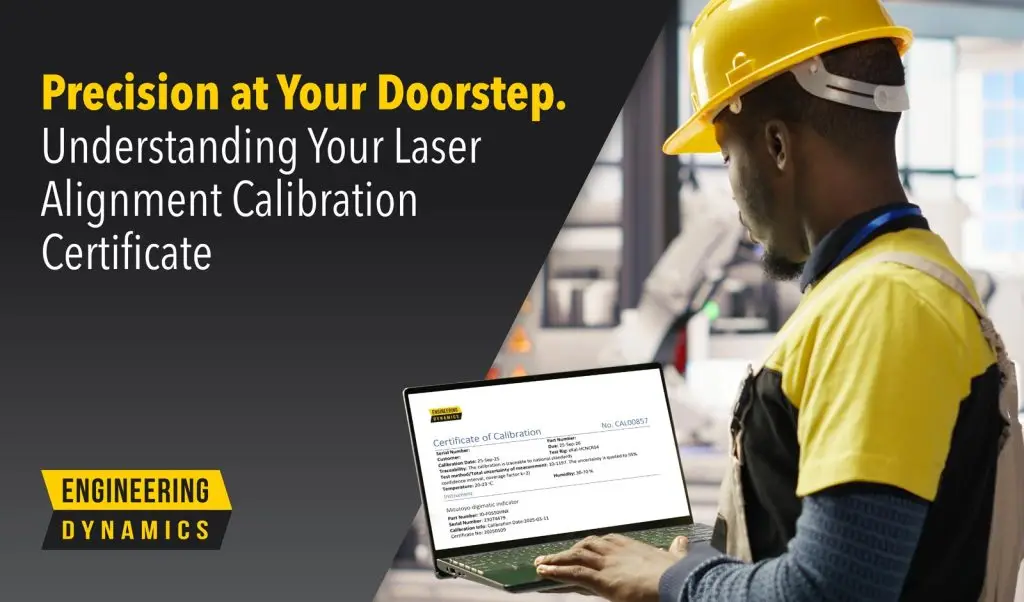

“Technician reviewing Engineering Dynamics calibration certificate on laptop”

Why Calibration Matters 

In industrial machine repair and installation, precision is everything. Even a tiny deviation of a micrometre can lead to thousands of Rands in downtime, lost production, or safety hazards. Therefore, calibration is vital. It ensures that your equipment is properly adjusted and officially recognised as compliant through formal documentation.

That documentation is your calibration certificate.

This certificate is a comprehensive record confirming that your equipment has been inspected, adjusted, and verified against recognised manufacturer standards. Moreover, it serves as both your assurance of quality and the foundation of compliance, particularly in demanding sectors such as mining across Africa. The real question is whether you fully understand what the data in this record represents, and whether you are making the most of the quality in which you are investing.

Every Easy-Laser calibration carried out by Engineering Dynamics comes with a formal report that captures the entire process. Specifically, this includes:

  • Traceability to international standards.
  • Before and after readings for every adjustment, including laser power, inclinometer angles, detector alignment, and parallelism.
  • The measurement uncertainty.
  • Environmental conditions.

Engineering Dynamics ranks among a select few centres worldwide accredited by the leading laser alignment OEM, Easy-Laser. Furthermore, every two years, the Easy-Laser quality team re-certifies our technicians, ensuring that the expertise applied during calibration meets international standards.

For years, African industries had to send vital measurement tools overseas, often waiting months and incurring high costs. However, with our accredited facility for Easy-Laser products in Pretoria, we have transformed that process. Calibration at Engineering Dynamics is now faster, more consistent, and fully traceable. Typical turnaround is just one day, which means you get a certified tool back in the field almost immediately, maximising operational uptime.

Automation and careful monitoring reduce human error and guarantee repeatable results. At the same time, every report documents the adjustments and measurements in full, giving you complete transparency.

Key Steps in the Calibration Process

  • Inspection and Cleaning
    Every system undergo thorough cleaning and inspection for any physical damage that could impact performance. Even a small mark on a laser head can lead to non-compliance, and this is noted in the report.
  • Laser Power Measurement
    The laser output is measured with a calibrated optical power meter. Technicians then adjust it to the precise factory specification of 0.420 ± 0.02 mW. The certificate records the before-and-after values, allowing you to see the exact improvement.
  • Inclinometer Calibration
    The inclinometer is tested at eight reference angles, spaced 45 degrees apart. Graphs on the certificate show the inclinometer readings before and after calibration, together with the accepted limits.
“Graph showing angular deviation data for calibration certificate”

Figure 1:
Blue=Before Adjustment, Green=After Adjustment
Red line = Inclinometer accuracy.

  • Position-Sensitive Detector (PSD) Calibration
    Both the vertical (Y) and horizontal (X) detectors are calibrated. Using a Mitutoyo dial gauge, the detector is moved in 1 mm intervals while the laser remains fixed. This allows Engineering Dynamics to fine-tune the linearity of the detector to within ±5 μm ±1 percent. Graphs are included in the report to clearly show the accuracy before and after adjustment, along with the calibration limits.
“Calibration graph showing PSDY deviation versus gauge position”

Figure 2: PSD Y Deviation (mm)
Blue=Before Adjustment, Green=After Adjustment.
Red line=Calibration limits

“Calibration graph showing PSD X deviation versus gauge position”

Figure 3: PSD X Deviation (mm)
Blue=Before Adjustment, Green=After Adjustment.
Red line=Calibration limits


  • Parallelism Check
    This is a crucial check to confirm the laser beam is perfectly parallel to the device’s physical mounting rods. We measure for any horizontal deviation when the detector is moved 100 mm vertically, which must be less than the factory limit of 0.030 mm. This ensures that vertical adjustments are not mistakenly recorded as horizontal misalignments. The certificate displays both the pre-calibration and post-calibration values, along with the calculated parallelism.
“Graph comparing BC and AC calibration data sets”

Figure 4:
Parallelity Before Calibration: 0.0074 (mm/100 mm)
Parallelity After Calibration: 0.0012 (mm/100 mm) 
Dotted lines are the upper and lower values used for the calculation of parallelism for the AC Line.

To make this more tangible, we provide a downloadable sample [insert PDF link]. Together with the graphs in this article, it demonstrates exactly what is measured, how it is recorded, and why it matters.

Contact Engineering Dynamics today to schedule your Easy-Laser calibration and receive the documentation that confirms accuracy, compliance, and long-term reliability. Every certificate is a record you can trust, a safeguard for demanding environments, and a practical assurance that your equipment is performing optimally. When precision is properly recorded and certified, it is no longer just a technical detail. It becomes your operational advantage.

Share this article below

Latest Articles

Read more about similar topics:
Blue background with text "WHY CONDITION MONITORING Reduces Downtime" and Engineering Dynamics logo.

Why Condition Monitoring Reduces Downtime

Condition monitoring is changing how maintenance works in many industries by moving from fixing things after they break to addressing problems before they happen. By keeping an eye on important factors like vibration and temperature, engineers can spot early signs of trouble, avoiding expensive repairs and increasing the lifespan of equipment. With modern sensors and smart diagnostic tools, maintenance teams can respond to small issues before they grow. This forward-thinking method not only improves safety and efficiency but also protects operations in vital areas like mining and manufacturing. Find out how using structured condition monitoring programs can enhance your operations and improve your profits. Keep reading to learn more!

Discover More »
Text on blue background reads “HOW VIBRATION ANALYSIS Works in Condition Monitoring.”

How Vibration Analysis Works in Condition Monitoring

Vibration analysis is a key tool in monitoring equipment conditions, allowing for early detection of mechanical problems like imbalance and misalignment before they cause expensive downtime. By using techniques such as spectrum analysis and regular checks, companies can improve equipment reliability and extend the life of their assets. This article explores how vibration analysis works, its importance in avoiding failures, and practical ways to implement it. Learn how organized monitoring programs and ISO-based training can help your team understand data better and take action. Read on to discover how to enhance your machinery’s performance!

Discover More »

Step-by-step procedure to align your machines

Free Download