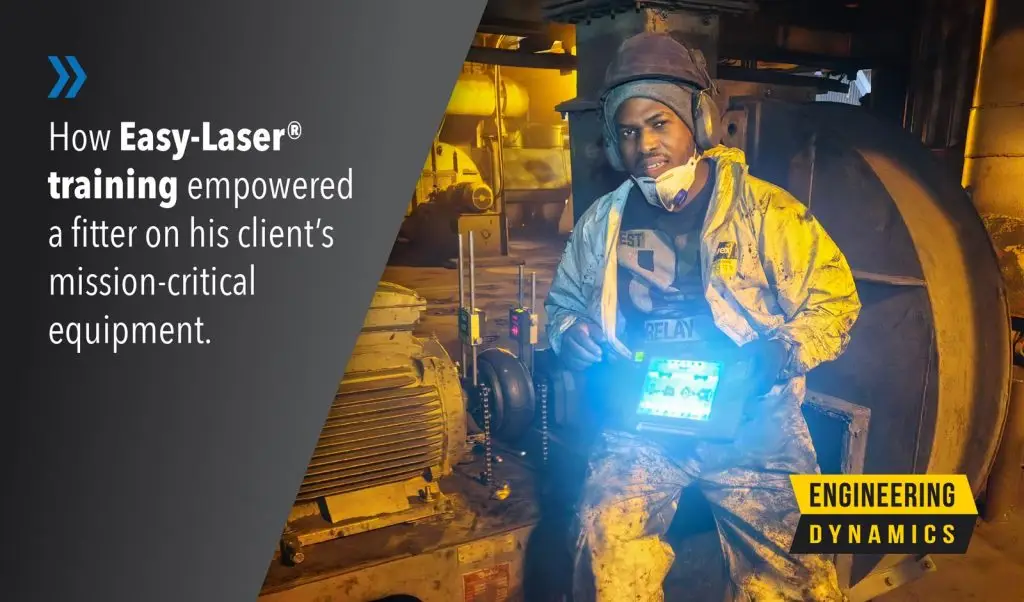
When Mahlubi-Andile Langalibalele arrived at Engineering Dynamics’ Precision Laser Shaft Alignment Training course, he was eager to get hands-on with the Easy-Laser® equipment. “The training was well presented and easy to follow,” he says. “The instructor clearly had first-hand knowledge, and this made the concepts clear and practical.”
He completed the course successfully. But the real test came later.
Back at the plant, Mahlubi-Andile found himself in a high-pressure situation. Although his company already owned a laser alignment system with Easy-Laser accessories, they had always relied on an outside contractor to perform the work. He would be the first in-house fitter to do it himself.
“I was nervous,” he admits. “But I applied everything I’d learnt at Engineering Dynamics.” The results speak for themselves. To date, he’s completed more than 30 successful shaft alignments on key equipment in the plant.
These include critical drive train components such as the main motor, gearbox, pinion and main gear driving the mills, as well as high-speed seal air fans running at 1400 r/min. His efforts have not gone unnoticed. He is now one of only two people in his company qualified to perform laser alignment, and his consistent results have earned him strong recognition on the plant floor.
“The training gave me confidence,” he says. “It’s boosted my self-esteem and allowed me to step up professionally.”
Next on Mahlubi-Andile’s radar is Vibration and Balancing Training. This is especially relevant to his plant’s 24/7 fan systems. “I’ve learnt how essential these skills are,” he says. “And I know where I want to learn them.”
For more on how Engineering Dynamics is modernising technical training, read this success story. Explore our full range of training courses and discover the benefits of our loyalty programme and our calibration centre on-site.
Share this article below
Related to this Topic
Read more articles related to this topic
How Vibration Analysis and Balancing Training Prevents Failure
How Vibration Analysis and Balancing Training Prevents Failures Preventing equipment failures begins with proper training. At Engineering Dynamics Pretoria, our
Why Condition Monitoring Reduces Downtime
Condition monitoring is changing how maintenance works in many industries by moving from fixing things after they break to addressing problems before they happen. By keeping an eye on important factors like vibration and temperature, engineers can spot early signs of trouble, avoiding expensive repairs and increasing the lifespan of equipment. With modern sensors and smart diagnostic tools, maintenance teams can respond to small issues before they grow. This forward-thinking method not only improves safety and efficiency but also protects operations in vital areas like mining and manufacturing. Find out how using structured condition monitoring programs can enhance your operations and improve your profits. Keep reading to learn more!

How Vibration Analysis Works in Condition Monitoring
Vibration analysis is a key tool in monitoring equipment conditions, allowing for early detection of mechanical problems like imbalance and misalignment before they cause expensive downtime. By using techniques such as spectrum analysis and regular checks, companies can improve equipment reliability and extend the life of their assets. This article explores how vibration analysis works, its importance in avoiding failures, and practical ways to implement it. Learn how organized monitoring programs and ISO-based training can help your team understand data better and take action. Read on to discover how to enhance your machinery’s performance!


